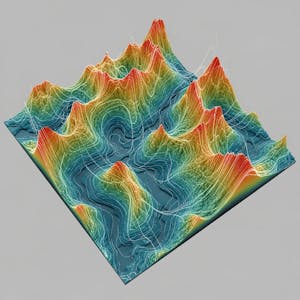
Unity: Design Procedural Surfaces with Noise Functions
About this course
Design dynamic procedural surfaces in Unity using noise functions and build reusable systems for real-time visualization. This intermediate-to-advanced course takes you through the complete process of creating procedural textures, generating terrain-like surfaces, computing derivatives, and visualizing flow using particle systems and scripting. You’ll begin by exploring procedural noise, texture generation, coordinate transformations, and resolution control before progressing to delegate-based noise functions, Perlin noise, gradient masks, frequency scaling, and multi-octave layering. Next, you'll generate and modify procedural mesh surfaces, extract directional derivatives from sampled noise, and analyze slope and flow behavior. Finally, you'll transform procedural data into visual flow fields by applying smoothing techniques, particle systems, directional vectors, and Unity scripting to create dynamic visual output. Designed for learners with prior Unity experience, this course emphasizes reusable programming practices, modular procedural systems, and real-time visual feedback. Each module builds on the previous one, allowing you to develop and validate progressively more advanced procedural workflows. By the end of the course, you will have built a fully operational procedural surface and flow visualization system that can be extended for games, simulations, or generative art projects.
75/100
CourseAsk score
- What the provider tells you
- 39/45
- Who stands behind it
- 20/35
- How complete the listing is
- 16/20
Scores how much the provider publishes and who stands behind it — not how well it is taught.
What you'll learn
- Understand procedural noise and texture generation
- Create terrain-like surfaces in Unity
- Extract directional derivatives from sampled noise
- Analyze slope and flow behavior
- Implement particle systems for visual flow fields
Course objectives
- Build reusable procedural systems for real-time applications
- Gain proficiency in scripting with Unity
- Create dynamic outputs for games and simulations
Price shown by Coursera — confirm on their site.
Enroll on CourseraYou'll be redirected to Coursera to complete enrollment.
- Listed & compared by CourseAsk
- English · 0

 Udemy
Udemy

 edX
edX

 Coursera